DpdoEngine — hochpräziser PCM→DSD-Konverter
Überblick
DpdoEngine ist der Kern der Dpdo-Produktfamilie. Er wandelt PCM-Audio (FLAC, WAV, AIFF usw.) in DSD-Formate (DSF, DFF, DST, WSD) um — mit durchgängiger 64-Bit-Doppelpräzision, konfigurierbaren IIR/FIR-Noise-Shaping-Filtern hoher Ordnung und einem reichen DSP-Toolkit. Multi-Stufen-Qualität vom Consumer- bis zum Audiophile-Niveau.
Technische Daten
| Spezifikation | Wert |
|---|---|
| Eingabeformate | WAV / FLAC / AIFF / ALAC u. a. PCM |
| Ausgabeformate | DSF / DFF / DST / WSD |
| Rechengenauigkeit | 64-Bit-Doppelpräzision |
| Noise-Shaping | IIR Ordnung 3–15 (Standard 9); FIR (Standard 4096 taps) |
| Oversampling | 64x–4096x (Standard 64x / DSD64) |
| Kompression | DST verlustfrei (30–50% Ersparnis) |
| GPU | OpenCL 1.2+ |
| Plattformen | Windows / Linux / macOS |
| Aktuelle Version | 6.75.0 |
Grundlegende Verwendung
DpdoEngine -i INFILE OUTFILE [OPTIONS]
Pflichtargumente:
- -i INFILE — Eingabe-PCM-Datei (FLAC / WAV / AIFF usw.)
- OUTFILE — Ausgabepfad (Format aus Erweiterung: .dsf / .dff / .dst / .wsd)
Beispiele:
# Basis: WAV → DSF, 64x Oversampling
	DpdoEngine -i input.wav output.dsf --oversampling 64

	# FLAC → DFF, 11-stufiges IIR-Noise-Shaping
	DpdoEngine -i input.flac output.dff --oversampling 128 --order 11

	# Voll: OpenCL + Metadaten + Report
	DpdoEngine -i input.flac output.dsf --oversampling 256 --order 7 --opencl --report --artist "Dpdo" --album "Demo"

	# WAV → WSD (Korg-Format), DSD64
	DpdoEngine -i input.wav output.wsd --oversampling 64
Oversampling
Gesteuert über --oversampling:
| Wert | Format | Typische Bandbreite |
|---|---|---|
| 64 | DSD64 | ~30 kHz |
| 128 | DSD128 | ~60 kHz |
| 256 | DSD256 | ~120 kHz |
| 512 | DSD512 | ~240 kHz |
| 1024 | DSD1024 | ~480 kHz |
| 2048 | DSD2048 | sehr breit |
| 4096 | DSD4096 | extrem |
Höheres Oversampling bringt breitere Frequenzantwort und weniger In-Band-Rauschen, aber linear steigende Rechenanforderungen.
Noise-Shaping-Optionen
IIR-Noise-Shaping
--order setzt die IIR-Ordnung. Unterstützt: 3, 5, 7, 9, 11.
# 15. Ordnung (höchste Spezifikation)
	DpdoEngine -i input.wav output.dsf --oversampling 256 --order 15
Höhere Ordnung: steilere Noise-Shaping-Kurve und größerer Dynamikbereich, aber höhere numerische Stabilitätsanforderungen. Ordnung 15 senkt das hörbare Bandrauschen auf bis zu -150 dB.
Unteroptionen:
- --pole 8.5 — Polplatzierung
- --zero — Nullstellenplatzierung
- --mash — MASH-Struktur
- --cifb — CIFB-Struktur
- --poly — polynomiales Noise-Shaping
FIR-Filter
--taps aktiviert den FIR-Modus:
DpdoEngine -i input.wav output.dsf --oversampling 64 --taps 4096
	DpdoEngine -i input.wav output.dsf --oversampling 64 --taps 4096 --window-type kaiser
Optionen:
- --taps N — Taps (auto, min. 4096 empfohlen)
- --beta V — Kaiser-Parameter
- --window-type — kaiser, blackman, flattop, bartlett, hamming, hanning, remez
GPU-Beschleunigung
DpdoEngine -i input.wav output.dsf --oversampling 256 --opencl
--opencl aktiviert OpenCL-GPU-Beschleunigung (OpenCL 1.2+). Besonders effektiv für FIR-Filterung und IIR hoher Ordnung.
Fortgeschrittene Signalverarbeitung
Mastering-Presets
DpdoEngine -i input.wav output.dsf --oversampling 256 --mastering-preset classical
	DpdoEngine -i input.wav output.dsf --oversampling 256 --mastering-preset pop
	DpdoEngine -i input.wav output.dsf --oversampling 256 --mastering-preset jazz
Equalizer
DpdoEngine -i input.wav output.dsf --oversampling 128 --equalizer "80:0.5:3,1000:1.0:1,8000:-0.5:2"
Format: <Frequenz(Hz)>:<Verstärkung(dB)>:<Q>, Bänder durch Kommas getrennt.
Harmonische Sättigung
# Soft-Clipping
	DpdoEngine -i input.wav output.dsf --oversampling 128 --harmonics tanh,0.5

	# Bandemulation
	DpdoEngine -i input.wav output.dsf --oversampling 128 --harmonics tape,0.3
Typen: tanh, poly, softclip, fullwave, tape.
Psychoakustisches Noise-Shaping
--psy nutzt auditive Maskierung zur Optimierung der Noise-Shaping-Kurve — gutes subjektives Klangbild auch bei niedrigem Oversampling.
Dynamikbereich
--lufs -16        # Loudness-Normalisierung auf -16 LUFS
	--rg              # ReplayGain-Normalisierung
	--lal             # Look-ahead-Limiter
	--apo             # Anti-Clipping-Filter
	--adaptive        # adaptive Parameter
Metadaten
DpdoEngine -i input.flac output.dsf --oversampling 64 \
	  --artist "Artist Name" \
	  --title "Track Title" \
	  --album "Album Name" \
	  --genre "Classical" \
	  --year 2024
Rückwärtswandlung (DSD → PCM)
DpdoEngine -i input.dsf output.wav --reverse
Gleiche 64-Bit-Doppelpräzisions-Engine in beide Richtungen.
Analyse-Berichte
DpdoEngine -i input.wav output.dsf --oversampling 64 --pdfrp
	DpdoEngine -i input.wav output.dsf --oversampling 64 --spectrogram
	DpdoEngine -i input.wav output.dsf --oversampling 64 --noise-profiling
--pdfrp erstellt einen umfassenden PDF-Bericht mit Parametern, Frequenzgang, Noise-Shaping-Charakteristik und Spektralanalyse.
Ausgabeformate
| Erweiterung | Format | Beschreibung |
|---|---|---|
.dsf | DSF | DSD Stream File, häufigstes DSD-Format |
.dff | DFF | DSD Interchange File Format, Rundfunkstandard |
.dst | DST | Direct Stream Transfer, DSD verlustfrei komprimiert |
.wsd | WSD | Korg Wideband Single-bit Data, Format des Korg-Recorder-/AudioGate-Ökosystems |
Weitere Dokumentation
- Vollständige Parameterreferenz
- WSD-Format — Erläuterung des Korg-WSD-Ausgabeformats
- DSP-Toolkit
- Batch & Aufnahme
DSD-Aufnahme
DSD-Aufnahme wird unterstützt: Echtzeit-Aufnahme vom ADC direkt in DSD (DSF) oder Stapel-Konvertierung vorhandener PCM-Dateien.
GUI-Edition
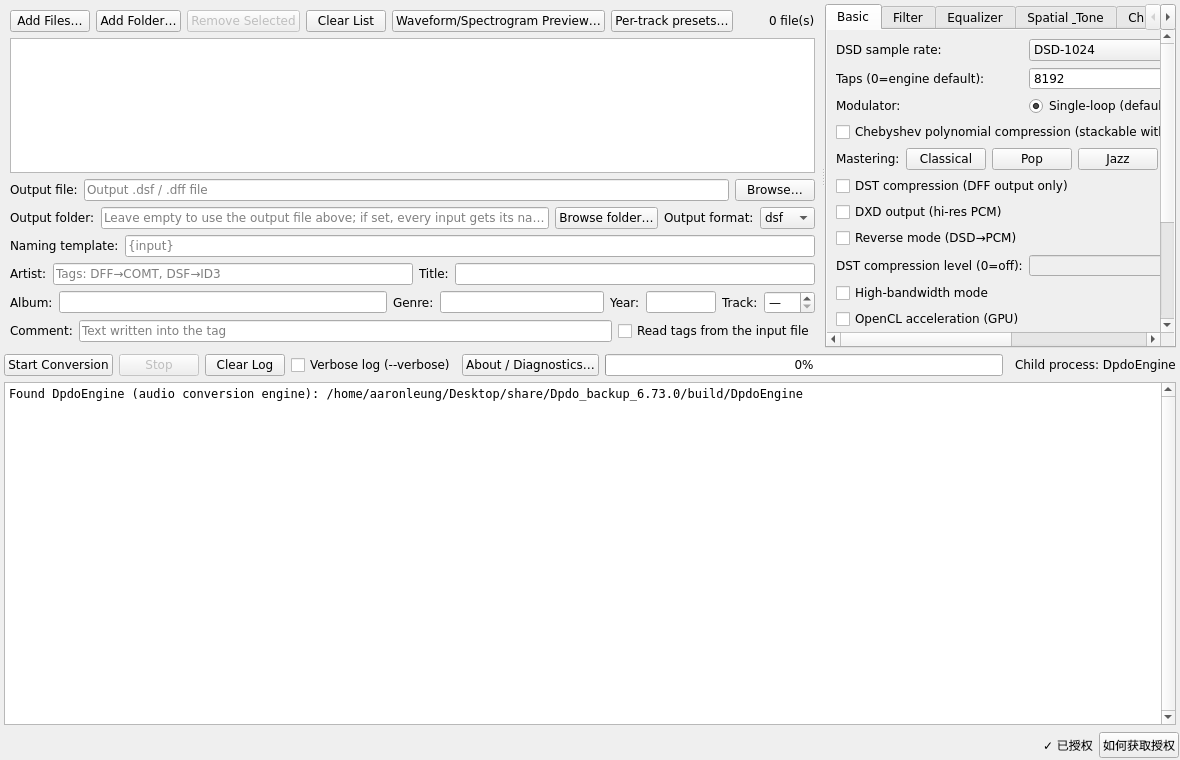
Oben: GUI des Audio-Toolkits (DpdoAudioTools). CLI-Edition: DpdoEngine.